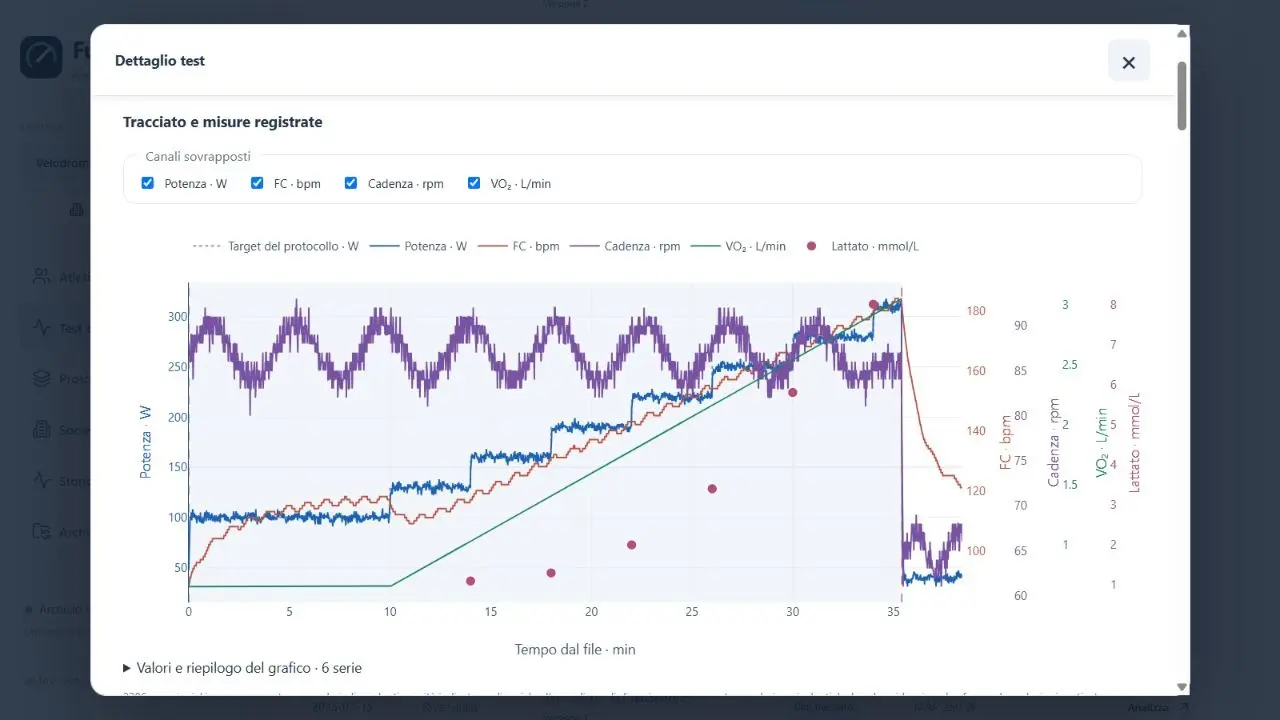
Fuorigiri Performance Lab is an application for coaches and trainers at cycling clubs. It keeps their athletes’ tests and lets them compare those tests over time, one season after another. It works offline, on a computer or a phone, and the data stays with the club.
Download the latest version Code on GitHub
| What it is | Archive and analysis of cycling tests: incremental, lactate, VO₂, sprint, Wingate, growth |
|---|---|
| For | Coaches, trainers and staff at clubs, especially youth clubs |
| Runs on | Windows 10 and 11, Android 8 or later |
| Status | Alpha: preview release, use with a backup |
| Licence | GPL-3.0-or-later |
Page updated on , for version 0.10.0-alpha.1.
Later changes are in the project's changelog.
Why it exists
In a cycling club, and even more in a youth one, riders’ tests end up scattered all over the place: FIT files, spreadsheets, PDFs from testing centres. On its own, each measurement makes sense. The trouble starts when you try to put them together, because it becomes hard to see how a rider is developing, or how a group is doing compared with last year’s.
The tools out there work very well for an individual athlete’s day-to-day training, or for paid metabolic modelling. Of the ones I tried, though, none brought together a youth club’s test archive and the riders’ growth without needing a server.
I built it mainly with Progetto Ciclismo - Rodengo Saiano in mind, the club I work with.
What it does
- It keeps profiles and groups: athletes, categories, seasonal groups and anthropometric measurements, with their history.
- Incremental tests are imported from FIT or CSV, or entered by hand, with lactate, VO₂ and training zones.
- 30- and 15-second sprint and Wingate tests stay separate methods, and are only compared with each other.
- For growth and maturation it calculates growth velocity and estimates peak height velocity, always stating the method and its limits.
- History and comparisons show mean, median and number of measurements, and missing data is not hidden.
- Reports come out as PDF or Markdown, by club, group, season or athlete. Collaborators share the data encrypted, over WebDAV or a shared folder.
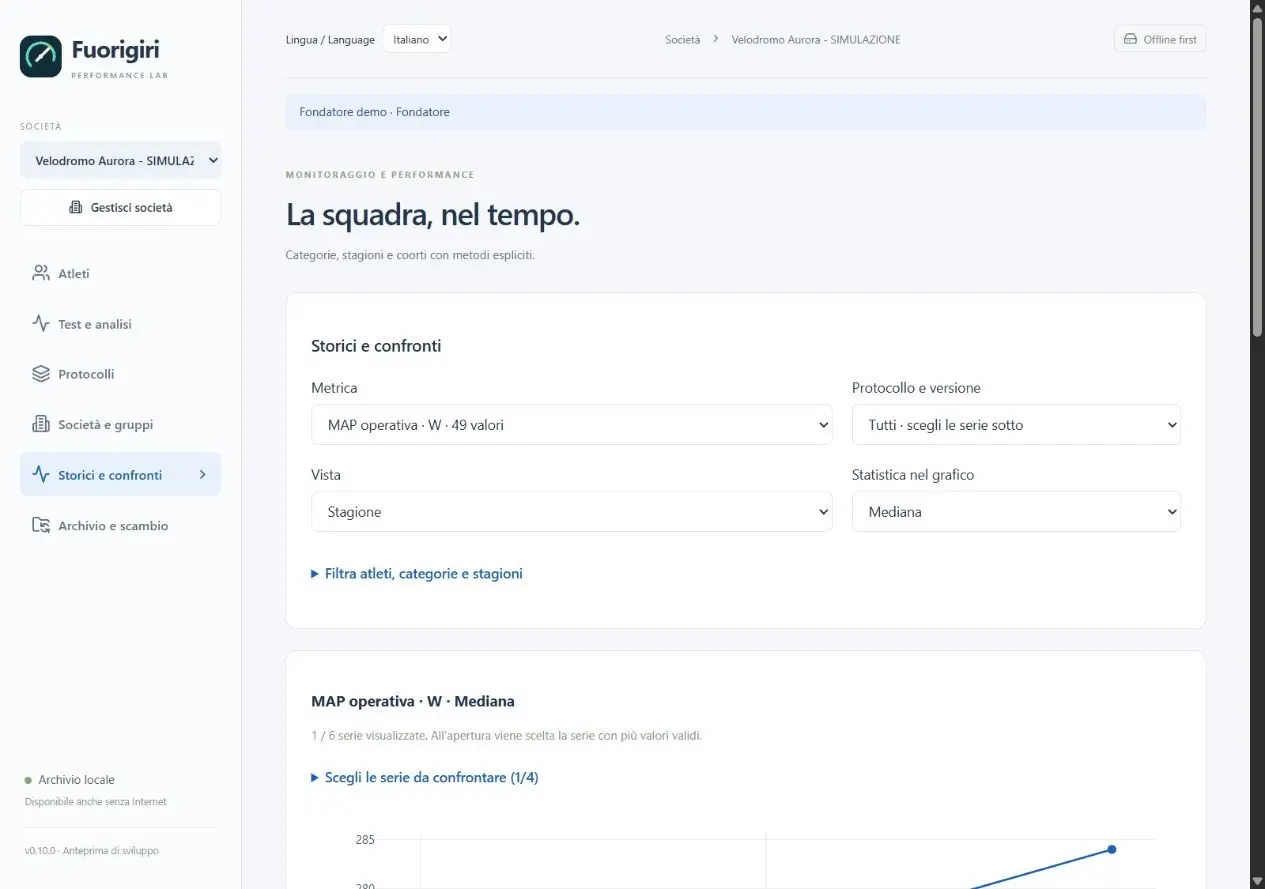 History and comparisons: one indicator season by season, with the sample size always in view. All data in the images is synthetic. The screenshots show the Italian interface.
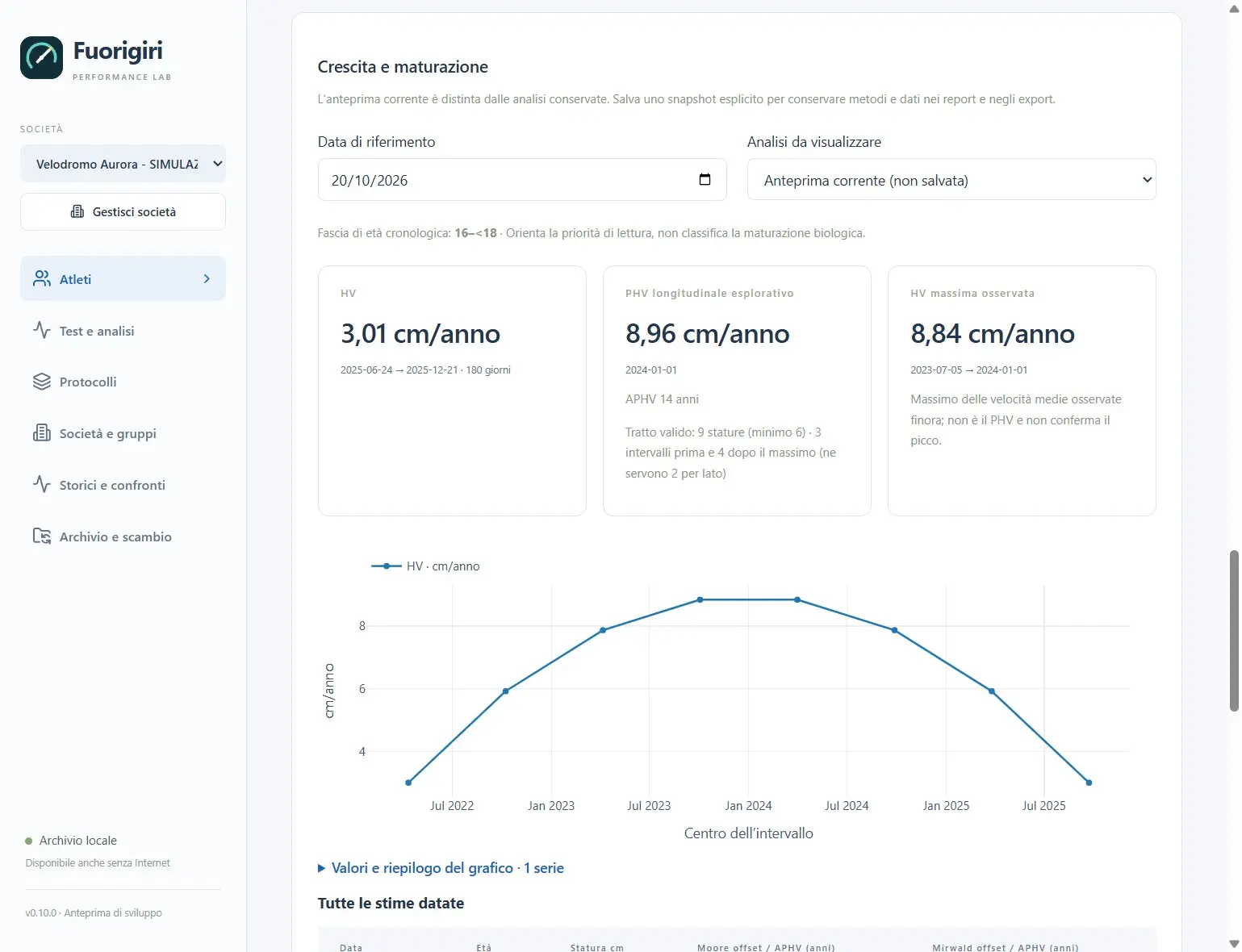 Growth and maturation in a test athlete’s profile.
Try it
- From the releases, download the installer or the portable ZIP for Windows, or the APK for Android.
- Create a sample club and add an athlete.
- Record a test by hand, or import one of the files from the synthetic corpus.
- Open the athlete’s profile and export a report.
If you would rather start from source, the steps are in the getting-started guide (in Italian). The shared interface and runtime libraries live in a separate repository, cycling-suite-common.
Where it stands
You can find the current status in the summary at the top, and the README says exactly what has and has not been tested. So far the app has been tested on Windows with Defender on, on a Pixel 9 and with WebDAV sharing. During the alpha, the biggest open question is external validation of the scientific methods. Whatever version you use, back up an existing archive before upgrading it, and check that the backup restores.
Get involved
Problems and feature ideas go in the repository issues. Vulnerabilities, on the other hand, should be reported privately, as described in SECURITY.md.
If you are curious where these questions about young riders and their numbers come from, there is the series Youth cycling and professional careers.