This series looks at Italian youth cycling rankings and the transition to professional racing. Before presenting my numbers, I explain what research already knows and, above all, who the numbers in the following instalments describe. That is where almost all the mistakes lie.
Twenty years of research in a few paragraphs
At the junior road World Championships each nation can enter at most six riders, and only the highest-ranked nations get all six places. Juniors, or Under 19s, are seventeen- and eighteen-year-olds. Anyone who has raced at that level remembers how hard it is to earn selection. Reaching that start line means passing every selection process youth cycling can devise. You could hardly look more destined for success.
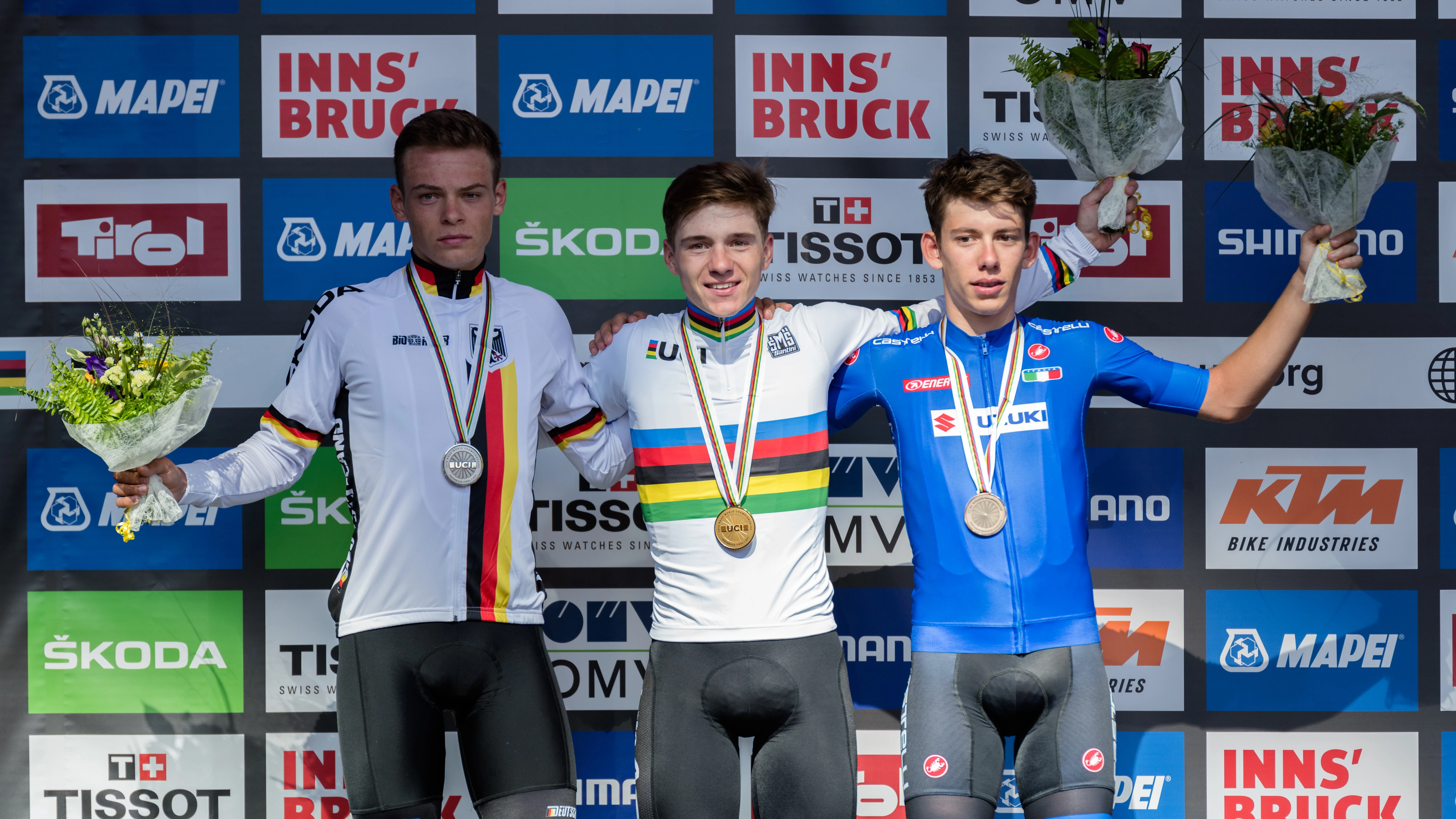
Yet even winning that race guarantees nothing. Since the junior road World Championships began, only three riders have won both the junior and elite titles: Greg LeMond, junior champion in 1979 and elite champion in 1983 and 1989; Mathieu van der Poel, junior champion in 2013 and elite champion in 2023; and Remco Evenepoel. He is the rider on the podium in the cover photo, taken at the 2018 junior Worlds in Innsbruck, which he won. His elite world title would follow four years later, in 2022.
In 2006 a German research group1 collected results from major competitions across twenty-five years of cycling: 27,454 results from 8,004 athletes in 108 countries, between 1980 and 2004, including disciplines beyond road racing. They then examined the same story in both directions. Looking forwards: how many junior Worlds riders subsequently contested a major senior event, meaning one of the races the study includes, from the Worlds to the Grand Tours? Thirty-four in a hundred. Looking backwards: among athletes with results in major elite events, how many had competed at the junior Worlds? 29.4 in a hundred.
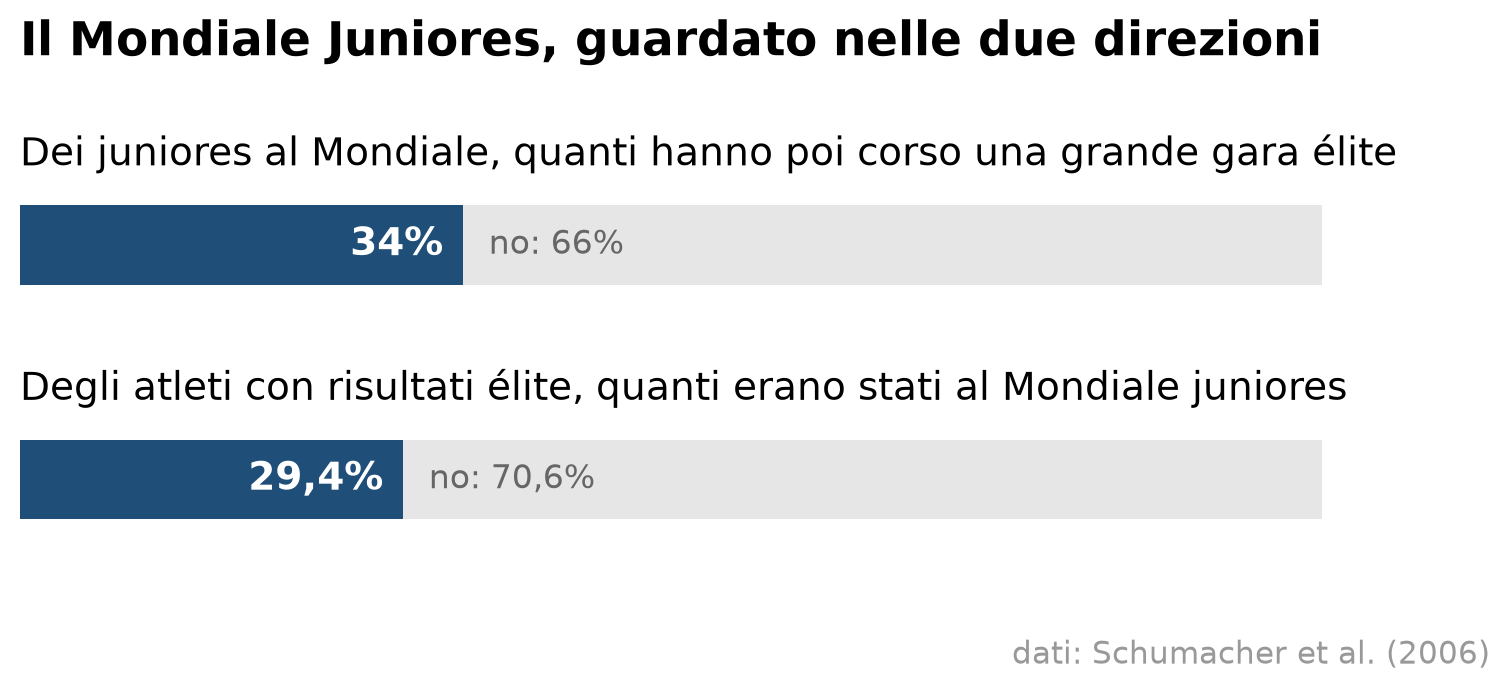
The percentages answer opposite questions, and neither goes much beyond a third: the majority is left out whichever direction you look.
These figures answer opposite questions and measure different things. Together, though, they say something uncomfortable: being fast as a youngster is neither essential for reaching the top nor remotely enough to guarantee it. Two in three apparent prodigies will never contest a major senior event, and seven in ten of those who reach those events never rode that junior championship. The question has since been revisited in Norway, Belgium, Spain, the Netherlands and twice in Italy, with very different samples and remarkably similar conclusions2. There are five main findings.
Future professionals were already performing better than their peers as youngsters. This is the most replicated finding in the field, reached by different groups using different methods.
The signal grows as riders get closer to the destination. The most cited Italian study, covering 1,345 riders in federation rankings, identifies the first Under 23 season, at nineteen, as the most informative point.
Below fifteen, by contrast, there may be little to see. A Belgian study of thirteen- and fourteen-year-olds measured maturation, coordination and motor skills. Together these explained just over a fifth of the differences in racing performance two or three years later. The interpretation was that at that age we are mostly measuring who developed earlier.
Then there are laboratory tests, where the finding sounds odd: threshold and watts per kilogram describe a youngster’s current level well, but add little about where they will end up. One exception is a Spanish study of 65 Under 23 riders, in which an eight-minute time trial separates future professionals fairly well. How well? Of those the test identified as future professionals, 54 per cent actually made it. Just over half, among riders around twenty who had already been heavily selected.
Finally, birth month: youth populations contain more riders born early in the year than demographics would predict, particularly at younger ages, while the effect is absent among those who make it. A study of almost three thousand Continental-team riders finds it mainly among those who did not succeed. In the second instalment I repeat that calculation on my own data, because it is the most reasonable doubt to raise about a finding at thirteen.
One finding recurs everywhere: the overwhelming majority of successful youngsters still do not make it. Every number needs its denominator attached; lining them up as though they measured the same thing is misleading. Two in three junior Worlds riders never contest a major elite event. Fifteen per cent of the top ten in Italy’s Allievi ranking, for fifteen- and sixteen-year-olds, subsequently scored WorldTour points, at the sport’s highest level. Five out of forty-eight riders in a complete Dutch year group reached a Continental team, the third UCI tier, or higher2. Both the starting populations, selected riders, the top ten or everyone, and the destinations differ. The scale changes each time; the direction stays the same.
Two gaps remain, and this series tries to fill them. Nobody has examined thirteen- and fourteen-year-olds using race results from a large population without prior selection: the Italian studies begin with Allievi, while the Belgian study includes Under 15s only if they had already achieved a top-ten finish. And no race-results study has reported how many of the youngsters identified actually make it. Yet that is precisely the number you would use to make a decision.
There are also two things the studies never disclose. I found neither in any of the twenty-two studies I summarised2, and noticed them while trying to reproduce the calculations.
The first is how many riders there were to begin with. Worlds selections, the top ten and ranked youngsters are already products of selection; nobody states how many came before. Without that number, percentages from two studies cannot be compared: they rest on different populations.
The second is that a youngster who stops appearing in rankings is often counted as having stopped racing. That is how the funnels in this literature are built: anyone absent from the next category is counted as lost. Nobody has checked how many disappearances are riders still racing without scoring points, or returning the following year. Later in this instalment I measure how many return. It is not a small number.
I cannot criticise this from above, because both points apply fully to my own study. My numbers also begin with an already filtered group, and I too see youngsters disappear from rankings without knowing whether they stopped racing or simply became slower. The only difference I can claim is that I measured these limitations rather than leaving them implicit. That is what the rest of this instalment is about.
The ranking behind everything
The study starts with the ranking published annually for every youth category by ciclismo.info. For 2007–2025 it contains 28,037 rider-season ranking entries for 11,094 boys3. Boys rather than girls, because of the numbers: female ranked riders number between a seventh and a tenth of male riders, women’s professional divisions have existed only since 2020, and there is no women’s Under 23 ranking, the most informative category among men. Where the question does not require knowing who made it, however, girls are included.
ciclismo.info is the most complete archive of Italian youth cycling available. One clarification is necessary: it is not the federation’s official archive, but an independent portal collecting and organising results. Nor does it include every young Italian cyclist. To enter, you need at least one point, and only the first five in each race score: five for the winner, down to one for fifth4.
How much does that filter matter? We can measure it, because the federation publishes membership totals by category each year5. The following figures are averages across several seasons.
| category | registered riders per season | ranked | share |
|---|---|---|---|
| Esordienti | 3,214 | 497 | 15.5% |
| Allievi | 2,673 | 371 | 13.9% |
| Juniors | 1,687 | 262 | 15.5% |
| Under 23 | 1,060 | 162 | 15.3% |
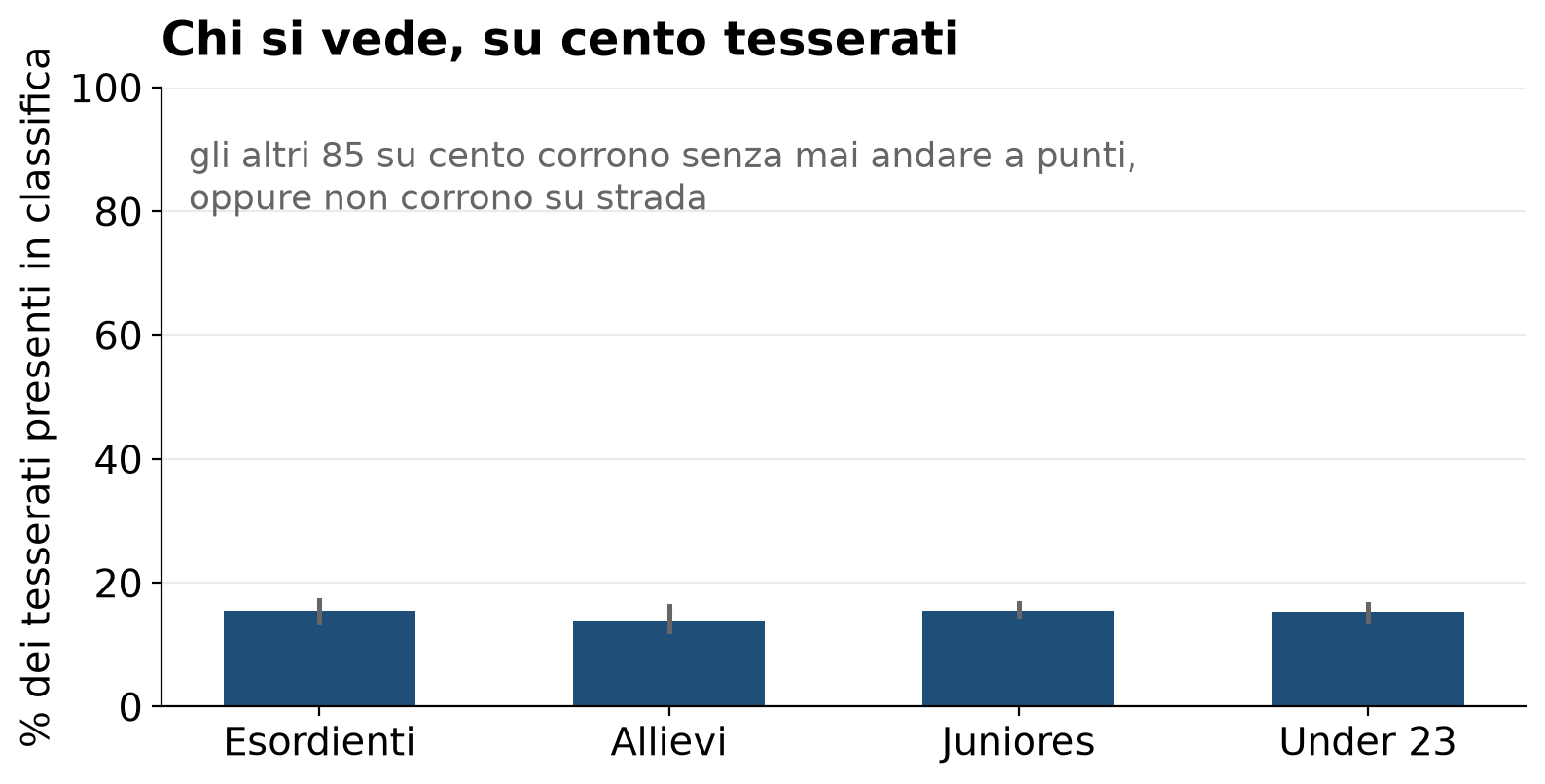
The bar is the seasonal average; the line spans the lowest and highest seasons. Membership includes riders in other disciplines who cannot appear in a road ranking, so one in seven is a lower bound.
About one registered rider in seven appears in the ranking. More striking than the figure is its stability: four categories, five to seven seasons each, always the same order of magnitude, ranging from 12.2% to 17.2%. The other six in seven race without scoring points, or compete in disciplines other than road cycling. Membership is by age category, not discipline: an Esordiente racing only mountain bikes is included in the total despite being unable to appear in a road ranking.
One in seven underestimates the share of road cyclists who become ranked, because the denominator contains riders who cannot enter the numerator. Even so, the ranking shows only the tip of youth cycling, and every number in the next three instalments describes that tip.
The cohorts, and the number I will keep using
The main cohorts, groups born in the same years whom I follow over time, are riders born between 1996 and 2000. All have had time to make it or not. There are 2,813 riders and 77 professionals. Throughout this series, professional means having raced for a first-tier WorldTeam or second-tier ProTeam by age twenty-five. The age window makes birth cohorts comparable; anyone who makes it later is not counted here.
Of those 2,813, however, only 2,183 were already ranked as Esordienti, the thirteen- and fourteen-year-old category, or Under 15s in the literature. Under 23 spans four birth years, from nineteen to twenty-two. The funnel starts with Esordienti6.
| category | ranked riders | of whom ranked as Esordienti | share of the 2,183 |
|---|---|---|---|
| Esordienti | 2,183 | 2,183 | 100% |
| Allievi | 1,741 | 1,303 | 59.7% |
| Juniors | 1,051 | 745 | 34.1% |
| Under 23 | 342 | 224 | 10.3% |
| professionals | 77 | 66 | 3.0% |
The two middle columns differ because each category also gains riders who were not ranked as Esordienti. The percentage uses the third column, not the second.
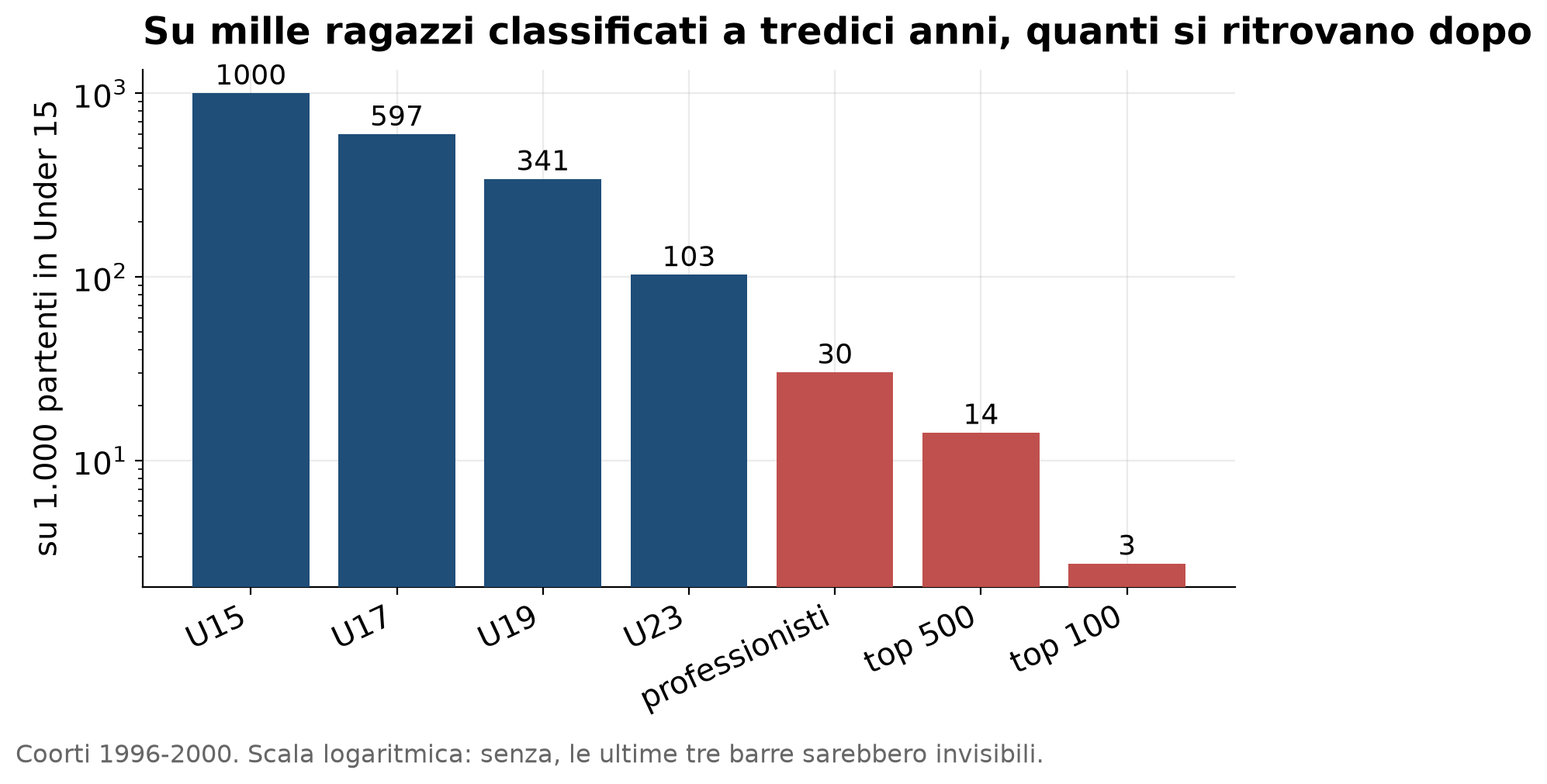
The first step already consists of riders with at least one top-five finish at thirteen; there are many more young Italian cyclists. The fall to the final step is thirty-threefold, far less than three orders of magnitude.
Look at the final row. The cohorts produced 77 professionals, but only 66 were already ranked as Esordienti; the other 11 entered later. Dividing 77 by 2,183 would put people in the numerator who are absent from the denominator. The share uses the sixty-six who actually started there: three in a hundred.
Read backwards, this is the most useful number in this instalment: one in seven future professionals was not ranked at thirteen. When looking at an Esordienti list knowing Italy’s best are on it, remember that one in seven of those who will make it is not there yet.
Those eleven include Christian Scaroni, a stage winner at the 2025 Giro d’Italia, and Jonathan Milan, twice winner of the Giro’s ciclamino jersey and winner of the 2025 Tour’s green jersey. Both first appear in our rankings as second-year Allievi.
It looks like a funnel, and partly is. But one feature defeats simple readings: it is not the same group shrinking. Between a quarter and a third of riders in each category never appeared as Esordienti; among Under 23s it is more than a third. Reading the funnel as ‘three hundred of those two thousand remained’ counts people as survivors who were never at the start.
The number I will use throughout the series therefore carries its label: twenty-seven per thousand among riders ever ranked, or 77 out of 2,813. The table’s three in a hundred is a different fraction: 66 out of 2,183, only those who started as Esordienti.
Three things to know before reading a ranking
First: disappearing from a ranking does not mean quitting. Some 30.6% of riders miss at least one season and then reappear; 6.7% of all riders return after at least two absent seasons.6 A return proves that the absence was not permanent withdrawal. Alongside the cohorts’ 77 professionals are 108 riders still scoring points after twenty-two who never became professionals, more than the professionals themselves. Not becoming professional does not necessarily mean quitting. This matters in the second instalment, when absence from a ranking becomes information to handle carefully.
For more detail in the technical document, in Italian: Leaving the ranking is not quitting, When riders quit and Is moving category a break?.
Second: how the categories work. For Esordienti the source publishes two separate rankings, one per birth year: first- and second-year riders have separate races and do not compete against each other. From Allievi onwards there is one ranking, with both birth years racing together. The consequence appears in the point-scoring places, the five finishes in each race that earn points7.
| category | share of places taken by first-year riders |
|---|---|
| Esordienti, separate rankings | 49.7% |
| Allievi, single ranking | 26.7% |
| Juniors, single ranking | 33.3% |
| Under 23, single ranking | 11.8% |
The juniors’ 33.3% interrupts the decline, and I cannot say why: first-year riders form a larger share of that category than they do among Allievi.
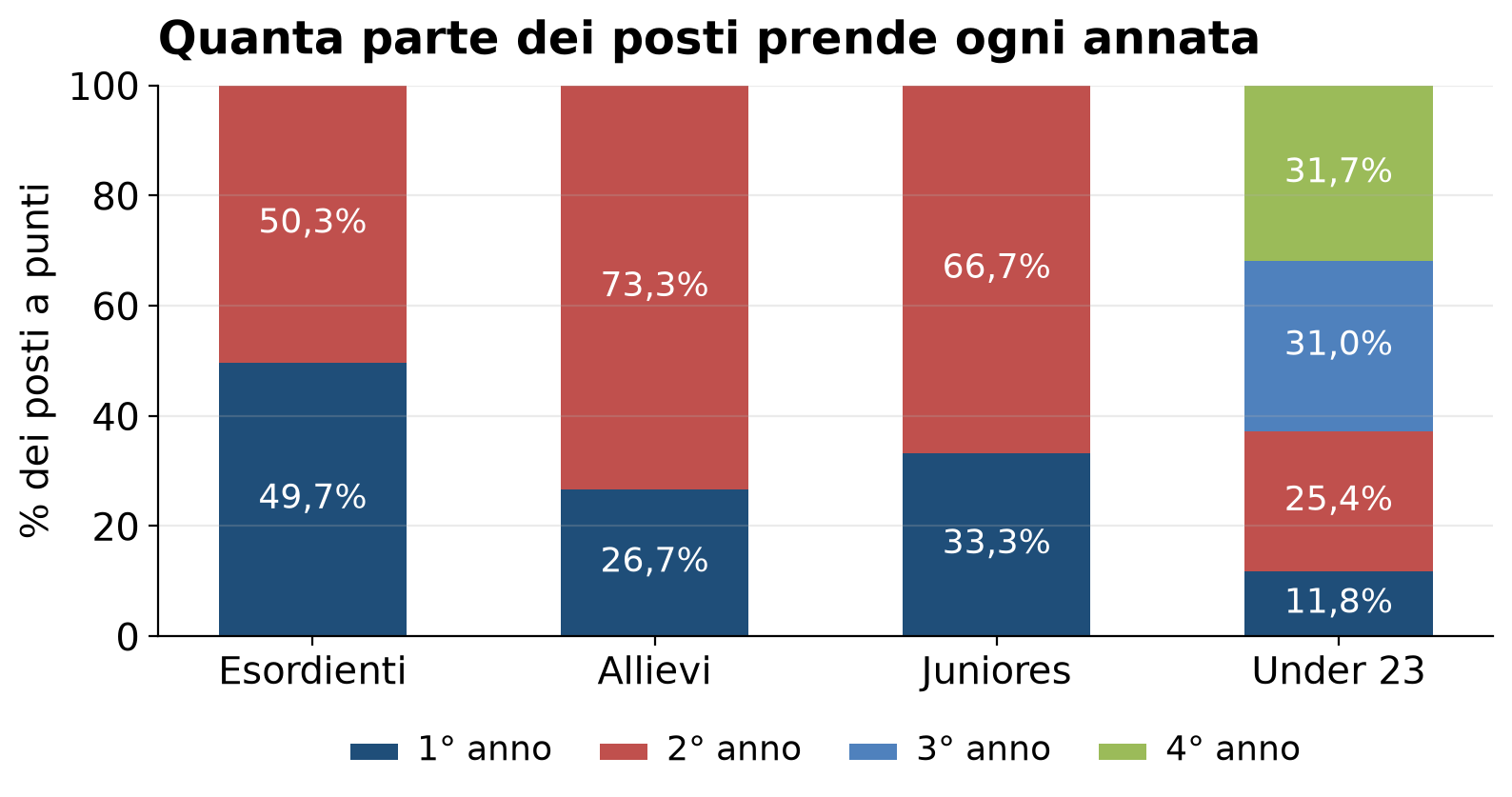
The Esordienti’s 49.7% is what two separate rankings would lead us to expect. What matters is the share left to first-year riders when there is only one list.
With separate rankings, an even split between birth years is unsurprising, and holds for girls too: each races against her own year group. The interesting question is how much younger riders collect when there is one ranking and everyone races together. Just over a quarter among Allievi, a third among juniors, an eighth among Under 23s. The benchmark is equality: half with two birth years, a quarter in Under 23, which has four. Relative to an equal division, first-year riders collect roughly half their share among Allievi and Under 23s and two thirds among juniors. Top-five places do not disappear: older riders take them. Reading a fifteen-year-old first-year Allievo’s ranking means looking at someone competing against opponents with an extra year of development.
Yet some already stand out against older riders: in 2011, Filippo Ganna collected 65 points and six wins as a first-year Allievo, finishing seventh in the combined ranking. He would go on to become twice world time-trial champion.
Women’s cycling also supports this explanation, because the source changed its structure along the way. Until 2021 female Esordienti had a single ranking, in which first-year riders took 28.5% of the places, similar to the men’s 26.7% in a different category and population. From 2022 there were two rankings and the share rose to half8, as expected.
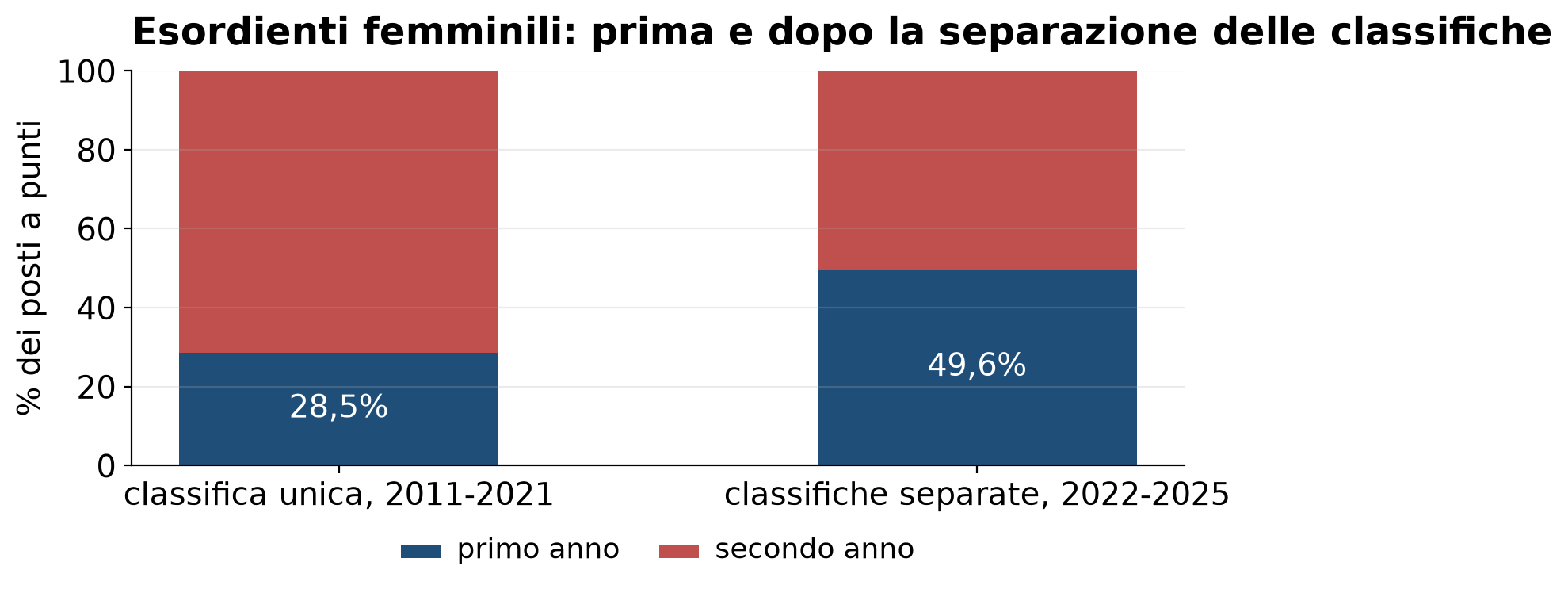
The same category and age, before and after the rule change. The informative number is the 28.5% on the left: what first-year riders collect when there is a single list.
For more detail in the technical document, in Italian: First-year riders do not disappear for lack of places, How concentrated the points are and A rule change as a natural experiment.
Third: the racing calendar is shrinking. In an average season the rankings record 320 Esordienti races and 146 Under 23 races. More importantly, between 2009 and 2025 recorded races fell by 40% for Esordienti and 58% for Under 23s. Was the pandemic responsible? No: the decline had begun earlier, and after 2020 numbers never recovered to previous levels. Within the comparable window, registered Esordienti fell by around a tenth and races by almost a fifth. The rider population is shrinking, and the calendar is shrinking faster.
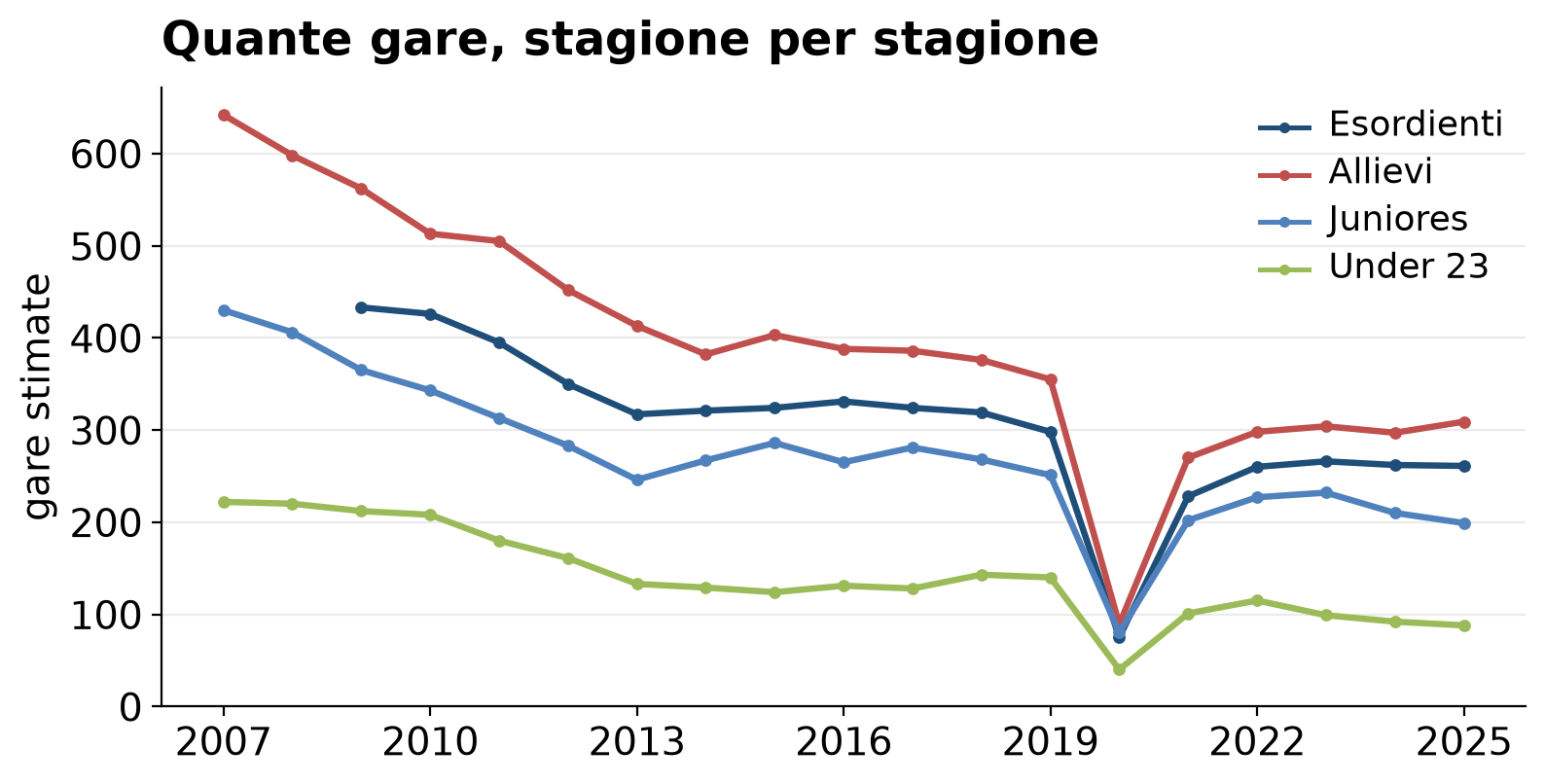
From 2007 to 2025: Esordienti fall from 433 races in 2009 to 261, Allievi from 642 to 309, juniors from 430 to 199, and Under 23s from 222 to 88, with a shared collapse in 2020.
Fewer races mean fewer point-scoring places, so the ranking thins by itself: distant year groups cannot be compared as though nothing had changed. The decline concerns men’s cycling, however, rather than all youth cycling. Where comparison is valid, among Allievi and juniors, men’s races fell by over a third between 2011 and 2025 while women’s held steady, narrowing the gap: from one women’s race per seven men’s races to one per five among Allievi, and from one per ten to one per five among juniors8.
For more detail in the technical document, in Italian: How many places there used to be and Ranking attrition and real attrition.
What the score measures
One last point about the instrument. In 2025 two Dutch researchers published the strongest criticism one could make of this kind of study: a federation ranking that does not weight races by level treats international races and local events alike.
For the Italian ranking, half that criticism is addressed, because the rules do weight races. Dividing points by the number of placings shows this indirectly: 2.67 points per placing among Esordienti, 2.73 among Allievi, 3.02 among juniors and 4.17 among Under 23s9. The jump occurs exactly where the rules’ multipliers start giving higher-level races more weight, from juniors onwards. For Esordienti and Allievi the scale is flat, consistent with the lack of an international calendar at those ages.
The other half still stands. A ranking rewards riders suited to the races most common on the calendar: a climber facing mostly fast courses has fewer opportunities to score. Correcting for that would require knowing each race’s characteristics, and those data do not exist.
For more detail in the technical document, in Italian: Does the same score mean the same result? and There are very many ties.
What remains
Every percentage in the following instalments has as its denominator one seventh of registered boys, an already selected group, rather than all of them. These results cannot therefore be extended to all registered riders. Exactly how far they differ, I do not know.
The funnel is not one group shrinking: each category includes a substantial share who were not ranked as Esordienti, and arriving late is entirely normal. One in seven future professionals was not ranked at thirteen. That is a different seventh from the registered-rider figure above, which measures the share who enter the ranking.
Now you know who we are talking about. At what age does a placing begin to say something about the future? That is the subject of the next instalment.
How we know
Rankings come from ciclismo.info, seasons 2007–2025. Membership totals come from statistical data published by the Italian Cycling Federation for 2018–2025. The series are not perfectly aligned: membership is by category, not discipline, so estimated coverage is a lower bound.
The literature review summarises twenty-two studies published between 2006 and 2025, giving full references, DOIs and limitations. I read five in full; for the others I used abstracts and cross-citations.
Schumacher Y.O. et al. (2006), Success in elite cycling: a prospective and retrospective analysis of race results, Journal of Sports Sciences 24(11), 1149-1156. DOI 10.1080/02640410500457299. ↩︎
All studies cited in this section, with references and limitations, are in docs/literature_review.md (in Italian). ↩︎ ↩︎ ↩︎
Calculated in report/moduli/provenienza.py. ↩︎
Italian Cycling Federation, Norme Attuative 2027, Cat. Esordienti / Allievi / Donne Esordienti / Donne Allieve, article 4.4.21 for the points scale and articles 4.2.1 and 4.2.5 for separate racing by birth year. These are federation rules, distinct from the rules the source uses to construct its ranking, which weights races by level. ↩︎
Calculated in report/moduli/copertura.py, using registered-rider totals collected in riferimenti/tesserati_fci.csv. ↩︎
Calculated in report/moduli/attrito.py. ↩︎ ↩︎
Calculated in report/moduli/posti.py. Places are estimated from top-five finishes, five per race. ↩︎
Calculated in report/moduli/ragazze.py. ↩︎ ↩︎
Calculated in R/30_misura.R, rendered by report/moduli/misura.py. ↩︎